HUMAN CENTERED AI
APPLAI
.gif)
Rethinking transparency and fairness in AI-assisted hiring workflows.
SCROLL DOWN ↓
HUMAN CENTERED AI
Rethinking transparency and fairness in AI-assisted hiring workflows.
SCROLL DOWN ↓
01. CONTEXT
Most people don't know how it works. Most never find out why they were rejected. And almost no one has a way to push back.
That felt like a design problem worth solving.
02. MY ROLE
I led the research phase, conducting stakeholder interviews and affinity mapping to frame the core problem. The resulting insights guided the team to pivot the product focus from résumé optimization to company accountability.
On the design side, I supported cross-fidelity prototyping and headed the evaluation strategy, which included an AI-assisted audit and moderated usability testing.
TEAM: MARIA CHANG · CICI XU · ALI HUANG
03. WHERE EVERYTHING FALLS SHORT
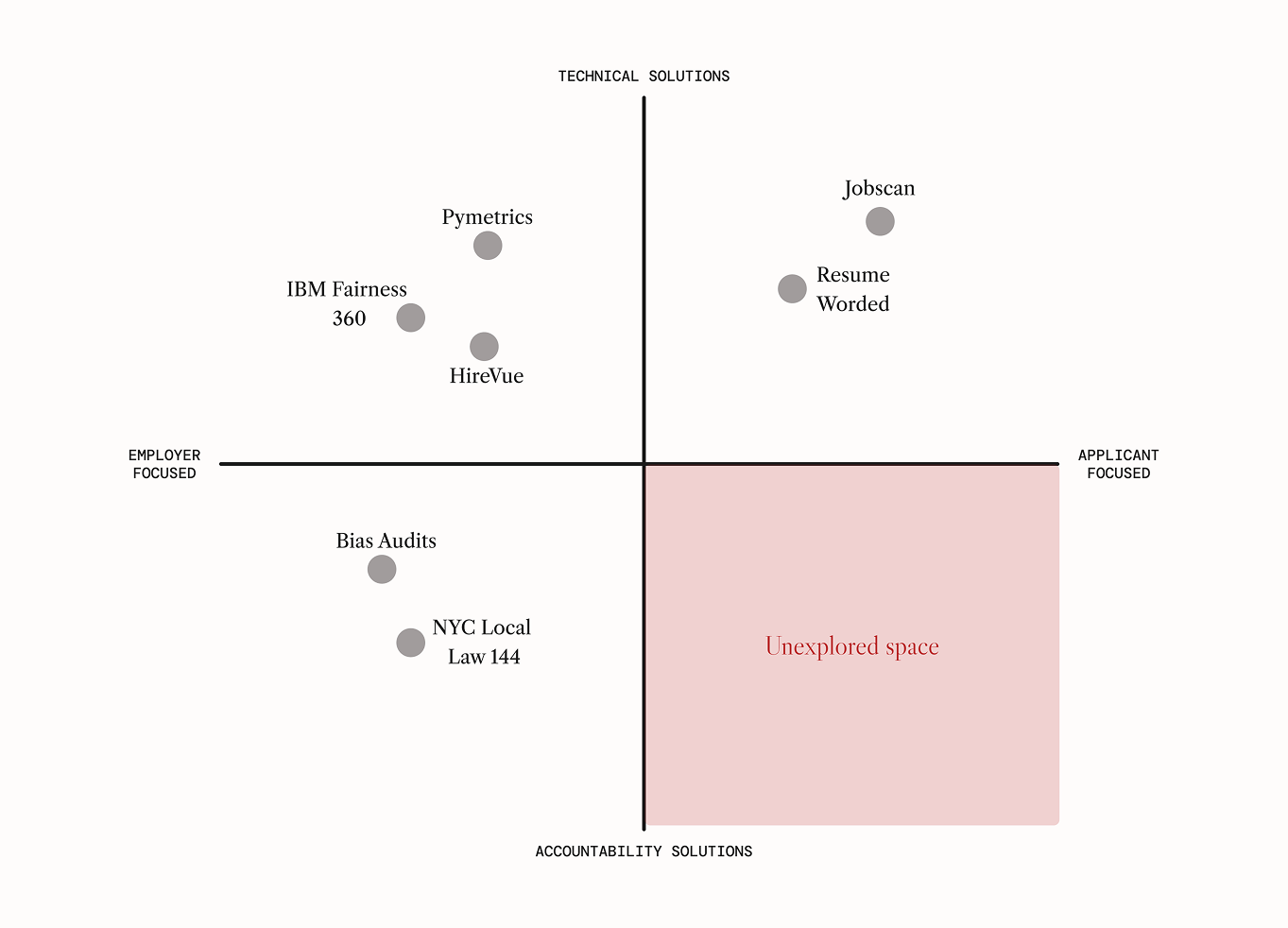
Employer-focused tools like IBM AI Fairness 360 are voluntary, while applicant-focused
tools like Jobscan simply optimize for biased systems rather than challenging them.
Even emerging legislation like NYC Local Law 144 lacks teeth, resulting in only two
complaints since enforcement began.
Without candidate-facing tools, automated screening bias often goes undetected,
leaving applicants with no process visibility or recourse.
04. ECOSYSTEM SYNTHESIS
We interviewed people across different groups: job seekers, recruiters, HR managers, and industry experts. Sessions ranged from 45-minute video calls to async written questionnaires. We coded transcripts for references to hiring tools, rejection communication, and accountability. Then we clustered patterns through affinity diagramming.
We got five insights with one shared conclusion: the system was built around employer needs, and applicants were an afterthought.
05. FRAMING THE SOLUTION
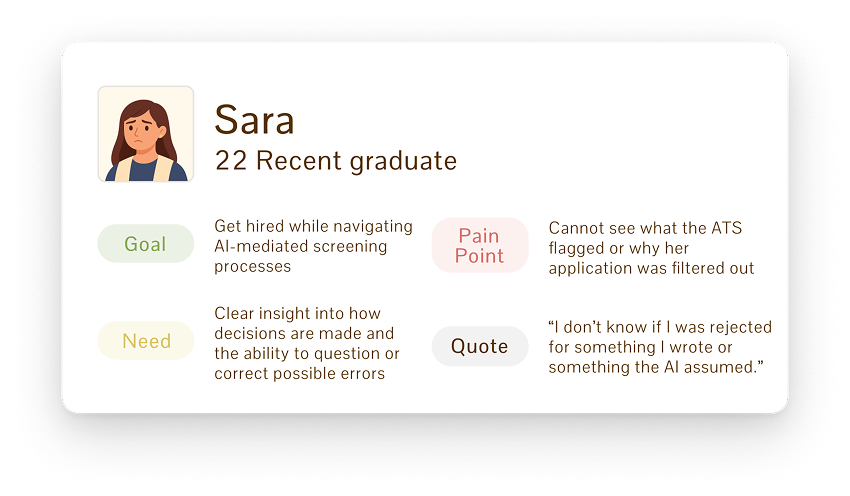
To turn these high-level market failures into an actionable design strategy, we mapped our research findings directly to the core user experience. Our goal was to shift the product focus from standard profile optimization toward true systemic transparency.
"I don't know if I was rejected for something I wrote, or something the AI assumed."
This baseline candidate anxiety anchored our feature prioritization, ensuring every subsequent design decision directly addressed the black box of automated screening.
06. THE DESIGN
We moved iteratively from low to high fidelity to map out our four core features. Early testing with job seekers helped us lock down the foundational layout, while consulting with industry experts between design rounds made sure our approach to AI transparency was actually realistic.
07. THE HARDEST CALL
OPTION A
Full Transparency Upfront
Surface bias signals, risk scores, and legal pathways immediately. Trust users to interpret the data and respect their autonomy.
CHOSEN →
Progressive Disclosure
Lead with empathy, follow with documentation, and escalate only when necessary. Meet users where their emotional bandwidth actually is.
We resolved the tension by making everything accessible from the start, but not prominent. The legal pathway is always one tap away — it just doesn't lead the experience. That tradeoff between full transparency and emotionally safe transparency is one I'd keep pressure-testing.
08. TESTING IT
6
ACTIVE JOB
SEEKERS
5
SCENARIO
TASKS
45
MINUTES PER
SESSION
WHAT LANDED
The tracker reduced fragmentation and built a sense of control. Familiar interaction patterns carried over cleanly from mid-fidelity, suggesting the model held up across fidelity levels.
WHAT NEEDED WORK
Status labels like "Verified" initially read as clickable buttons, while bias scores caused confusion without explanatory context. Because the legal features felt premature to users, our decision to leverage progressive disclosure was fully validated.
09. WHAT I LEARNED
Transparency without framing is just noise
Surfacing a bias score without explaining its meaning or next steps created anxiety instead of clarity. The goal is to surface the right thing at the right moment, not everything at once.
Accountability is a continuum, not a feature
Leading with legal support made users back away. The right sequence is to help people understand what happened, then document it, and finally escalate. Staging that progression respects both emotional and informational limits.
Who you optimize for changes everything
Most tools help applicants fit the algorithm. ApplAI helps applicants evaluate the company. Shifting the focus from self-optimization to employer accountability was the project's most consequential design decision, driven entirely by research.
10. WHAT I'D MEASURE
Fairness in AI hiring is more than a technical or regulatory challenge. It is a fundamental design problem, because the interface is where true accountability begins. To prove the interface is creating that accountability, we need to track four signal metrics that evaluate if ApplAI is driving systemic behavioral change rather than just capturing passive clicks.
Informed Drop-Off Rate
Tracking users who abandon an application after viewing company bias insights. This proves the tool successfully redirects talent away from toxic hiring practices.
Time-to-Clarity Metrics
Measuring the reduction in post-rejection ambiguity loops. Success means users spend less time wondering why they were rejected and more time taking actionable next steps.
Escalation Funnel Health
Monitoring the conversion rate from documentation to legal pathway activation. This helps us audit our progressive disclosure strategy and calibrate user trust.
Data Contribution Velocity
The growth rate of user-submitted rejection data. Because crowdsourced accountability relies on a network effect, contribution frequency is our primary proxy for platform trust.
11. WHAT'S NEXT
ApplAI's core data model depends entirely on applicant contributions. This creates a classic cold-start constraint: visibility into the most secretive, least transparent companies will be the hardest to build first. To overcome this hurdle, future product cycles would focus on three strategic pillars.
Automate tracking
Scaling the platform requires removing manual user burden. By integrating with job boards and deploying secure email parsing, we can automatically capture rejection data at scale to feed our crowdsourced loop.
Explain every signal
To prevent data panic, every automated score needs plain-language framing. Future iterations will translate raw confidence intervals into clear definitions, explicit uncertainty levels, and suggested next steps before the user faces any ambiguity.
Calibrate the Escalation Funnel
Accountability requires a staged framework. We must refine the onboarding experience so that high-stakes legal options and recourse tools only surface after the user has established a baseline of trust through our education and documentation features.